Tato Audio releases Aline, a sixteen-layer sequencer that treats composition like a language
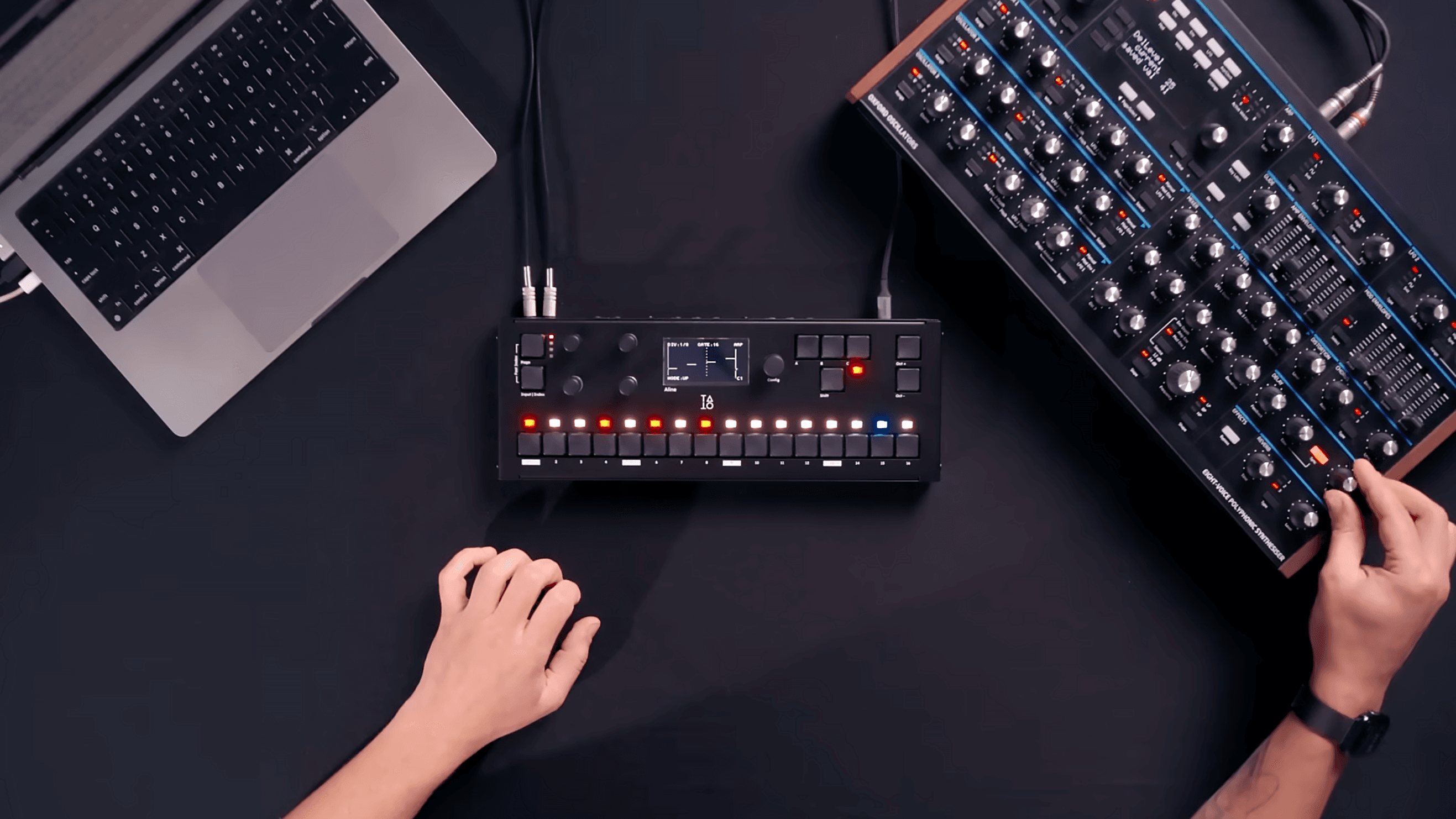
The sequencer landscape in 2026 is dense. Between the usual suspects, Cirklon, Hapax, Polyend Tracker, OXI One, and the ever-expanding catalog of Eurorack sequencing modules, standing out takes more than a spec sheet. The debut from São Paulo's Tato Audio, Aline, is leaning on a concept rather than a feature list: music as a language, and a sequencer as the tool for speaking it clearly.
Music as a language
Tato's designer opens the walkthrough video with an unusually direct design statement. Music is a language, he says, and a language has two parts: vocabulary and audience. The grammar and the words you use carry the story of where you found them and why you chose them, they reflect your journey as a musician. And language is always an exchange. Creation plus the people listening back.
From there, he positions Aline between two failure modes he wanted to avoid. On one side, the fully modular sequencer, where the possibilities are so open you get stuck staring at the grid. On the other, the fully generative sequencer, where the device decides for you what to say. Aline is pitched as something in between, a device that lets you perform your ideas most clearly and associate meaning with them.
Whether a piece of hardware can deliver on that kind of philosophical pitch is always an open question, but it's refreshing to see a builder articulate intent at that level instead of burying it under preset counts.

The engines, one by one
The bulk of the walkthrough is the designer stepping through each engine. Each of Aline's sixteen layers can be assigned one of eight engines, plus a few utility engines that sit outside the main lineup. Here's what's actually in the box:
Play
The straightforward one. Input notes in the time they appeal to you, or pipe them in from an external MIDI controller. No generative logic, no constraints. This is the engine for when you already know what you want to hear.
Grid
A matricial step entry engine. Pick a chord, input it across the steps, then edit voicings with the right hand. The grid gives you structure; the editing happens live.
Euclidean
Pick a root, and the engine generates a Euclidean rhythm (three notes over sixteen steps in the demo). Shift + size button changes the sequence length on the fly, five steps, eight, whatever. You can reduce or skew the distribution. There's a hidden detail here worth flagging: a second Euclidean layer runs on top of the first, dedicated purely to accents. That's how you get the velocity variation you hear in the demo without programming it explicitly.
Arp
A latching arpeggiator with multiple modes. Nothing flashy, but cleanly integrated with the layer system.
303
Loosely inspired by the TB-303 / TD-3 note entry flow, but clearer. Lay down the triggers first, then pick the notes. Clearly included as a nod to acid workflows.
Call & Response
The most conceptually interesting of the parametric engines. A probability wave sits on top of your sequence with an adjustable period, four, three, or two, and you specify how many notes to distribute across the wave's crests. Four notes over a period-three wave produces a very different phrase than four notes over period-two, and you can also offset the wave against the sequence. It's a compact way to generate patterns that feel like they have internal logic without programming them step-by-step.
Progress
Chord progressions via triggers. Enter a trigger and the engine generates a chord. Pitch it down, grow its size, or re-voice it. Shift + Page adds new pages for longer progressions. Any chord you don't like can be regenerated in place.
Line
The eighth engine, rounding out the parametric side. Not deeply demoed in the walkthrough.
The designer also mentions two utility engines outside the main lineup: Bank (a simple pattern bank) and Swiss (a Swiss-army engine for pitch, gate, and sequence rotation operations). Worth knowing about, even if they're not what the box is marketed around.

The index mode
This is the section of the walkthrough that rewards a second viewing.
Aline's structural claim is that layers can modulate each other, and the demo of it is satisfyingly concrete. The designer loads Progress on one layer, generating a chord progression. Then he enters index mode (Shift + Index), adds a new layer to the same instrument, sets its engine to Euclidean, and, critically, sets its destination not to the instrument itself, but to gate on the layer below.
The result: the Progress layer keeps generating its progression, but the Euclidean layer above it is now deciding when those chords sound. The two patterns have different lengths, which means the phrasing drifts and recombines every bar. He can then tweak either layer independently ,change just the progression, or change just the gate rhythm, and hear the interaction update live.
Index mode is where this whole architecture lives. Engine selection, destination routing, program change, instrument relationships, all centralized there. Get comfortable with index mode and the sixteen layers start to feel less like parallel tracks and more like a patching system with a screen.
Scale, pattern, and clock source settings also live in this area of the menu. Clock can run from MIDI, an analog source, USB, or internally, with automatic detection handling source changes without you thinking about it.
Building with euclideans
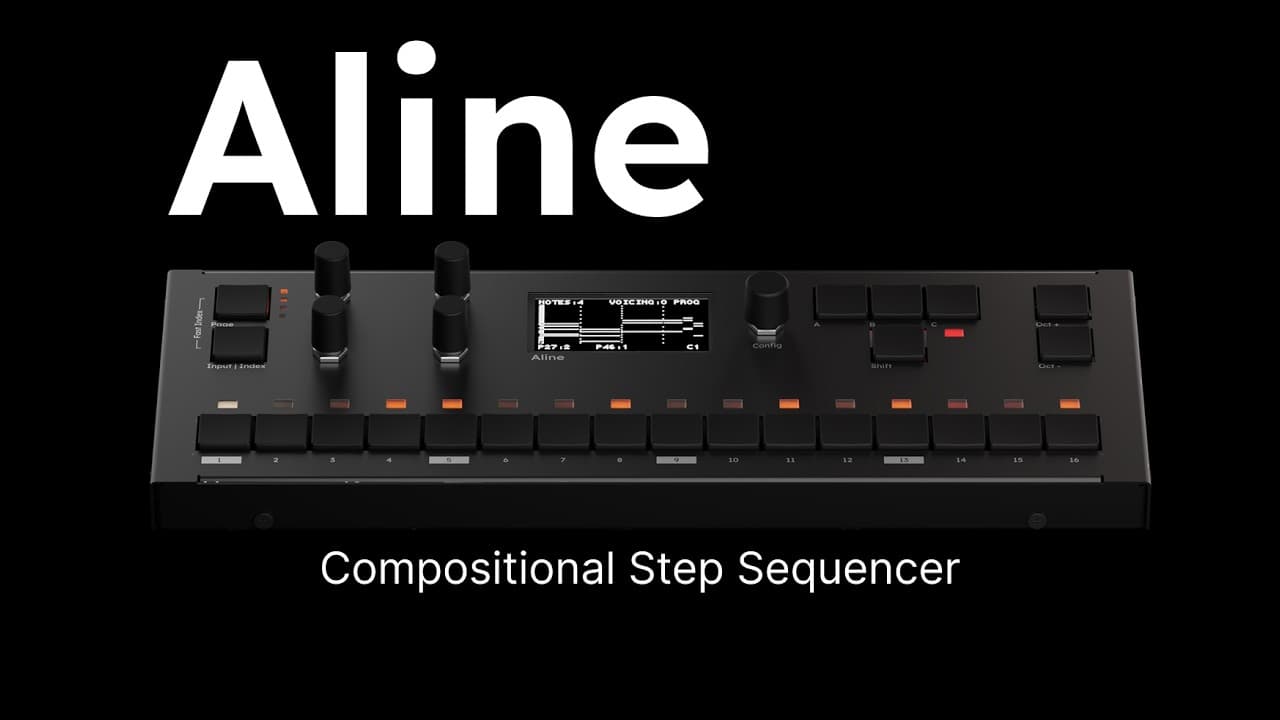
Tato has also posted a short tutorial that gives a better sense of what working on Aline feels like from a cold start. The designer powers the device on, walks through the two input modes, time mode and piano mode, and makes an offhand remark that's actually a design philosophy in itself: you can switch engines any time you want. Pick one, try another, switch back. "It's not a commitment," he says.
Most sequencers treat engine or mode selection as a destination, you commit to a workflow and live with it. Aline treats it as something you can flip between mid-session without losing your work.
The tutorial then builds up layers one at a time, all running Euclidean, but each with different lengths, octaves, and rotations:
- Layer 1: seven notes over sixteen steps, with the accent Euclidean adjusted to six.
- Layer 2: two notes over five steps, pitched to the fifth of the C Ionian scale (the scale displays directly in piano mode).
- Layer 3: a full octave up, nine steps, rotated.
- Layer 4: another octave away, longer notes, fewer of them.
By the time he drops a drum loop underneath, there's a full evolving pattern playing from what was essentially four parameter decisions per layer. The interplay of different sequence lengths is doing most of the work: layers running at five, seven, nine, and sixteen steps produce polyrhythmic relationships that drift across each other, and the second Euclidean accent engine mentioned earlier is adding velocity variation on top of all of it.
It's the kind of interlocking result that would take real effort to program step-by-step on a flat multi-track sequencer. And the way the designer moves, adding a layer with Shift + C, keeping it in the "same group," tweaking a single parameter and moving on, makes it clear the box is built for people who want to keep their hands moving, not people who want to plan every bar in advance.
-2.jpg&w=3840&q=75)
Connectivity
I/O is comparatively restrained, which may be a feature rather than a shortcoming. You get USB-C for MIDI and clock to a host, 3.5mm TRS MIDI in and out for external gear, and six 3.5mm CV jacks broken out as a clock I/O plus two channels of pitch, gate, and velocity for Eurorack.
Internally, the sixteen layers can be routed into fifteen instrument groups, which function like buses. That's how the modest output count actually scales up to controlling a real rig, a layer isn't tied to a physical jack, it's tied to a group, and the group handles routing to whatever's downstream.
It's enough to sit at the center of a small hybrid rig without swallowing an entire studio.
Aline at a glance
- 16-channel performance sequencer
- 8 engines split across parametric and imperative categories, plus Bank and Swiss utility engines
- Engines can target each other via index mode for layered interaction
- Sequence saving and recall
- Onboard keyboard with time mode and piano mode input
- 15 internal instrument groups
- Modular connectivity via 3.5mm CV
- MIDI via USB-C and 3.5mm TRS I/O
Specs
- MIDI: USB-C, 3.5mm TRS
- CV: 6 outputs
- Sync: 3.5mm I/O
- Power: USB-C bus power
- Dimensions: TBD
- Price: €499 / $600 USD
Final note and availability
Full disclosure before you take any of the above as gospel: I haven't put my hands on one yet. Everything here is pieced together from Tato's own material, the designer's walkthroughs, and a close read of the feature set.
On paper, though, it's one of the more conceptually interesting sequencer debuts of the year. We'll follow up once we've spent real time with it.