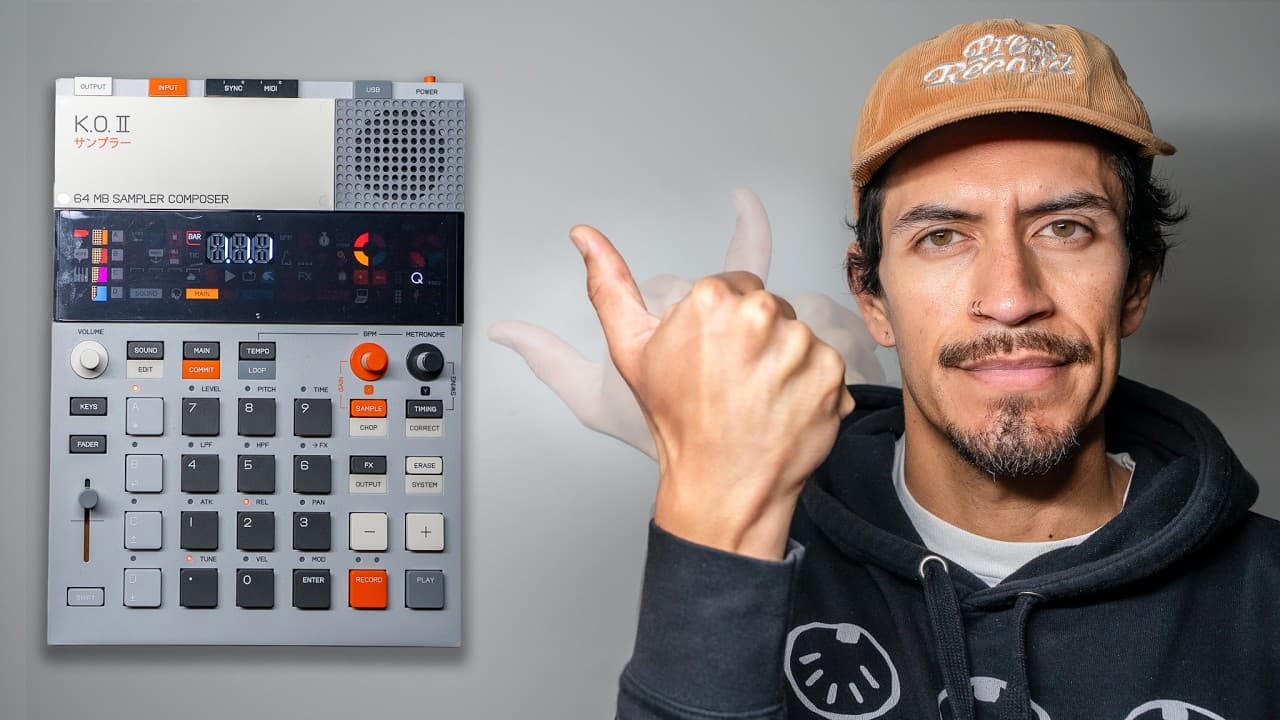
YouTuber and beat‑maker Ricky Tinez has put Teenage Engineering’s new OS 2.0 for the K.O. II (EP‑133) through its paces, calling the release “good, great, and weird” as he ticked off long‑requested fixes and a few pleasant surprises. Below is a breakdown of his verdict on the four features that mattered most in the review.
Hands free recording
Tinez says the update “fixed all of my gripes … We got hands‑free recording, we got resampling”. In his demo he shows the sampler grabbing perfectly‑timed loops from the internal resampler, external inputs, or the built‑in mic while the sequencer keeps running. After a few playful threshold‑misses, the take finally locks in and he declares fixed‑length capture “dope … awesome … I freaking love that thing.”
Sidechain dynamics
Side‑chaining was the biggest surprise and quickly became a must‑have: “This made me go back to all my projects on the EP‑133 and add this”. Rather than audio‑triggered pumping, the K.O. II uses the kick’s MIDI‑note events as a clean control signal, letting users dial in length and curve for predictable results. Tinez calls it “a way cleaner, simpler, and more predictable side chain sound” that keeps its shape even if you swap samples or mute the kick. He demonstrates fine‑tuning the duck to rhythmic perfection, noting the logarithmic‑to‑exponential curve options.
Saving sound edits
Another quality‑of‑life win is the ability to commit per‑sample tweaks. “Saving sound edits to sounds … is way more handy than you realize,” he notes, comparing the convenience to his workflow on Digitakt 2. Now shortened kicks and tailored rides persist across projects, sparing him from repeating the same envelope and level tweaks every time. “Being able to fine‑tune the samples that are on here has been great for me,” he adds, while cautioning that global edits could ripple into other tracks if reused.
Song mode impressions
Finally, Tinez tackles the new 99‑position song mode, dubbing it “a bit trippy” during a candid, often comical walkthrough. The nesting of layers, scenes, and group patterns quickly snowballs: “Just ignore song mode completely until you are completely done making your song in normal mode,” he advises, warning that mid‑song edits can unwittingly erase kicks or rewire patterns elsewhere. The power is undeniable, but so is the learning curve.
Bottom line: with hands‑free sampling, MIDI‑driven side‑chaining, and on‑device sound‑edit saves, OS 2.0 turns the pocket‑sized K.O. II into a far more capable groovebox. Song mode may take a little patience, but, as Ricky puts it, the update “fixed all of my gripes,” which is high praise from one of the sampler’s most vocal early critics.