

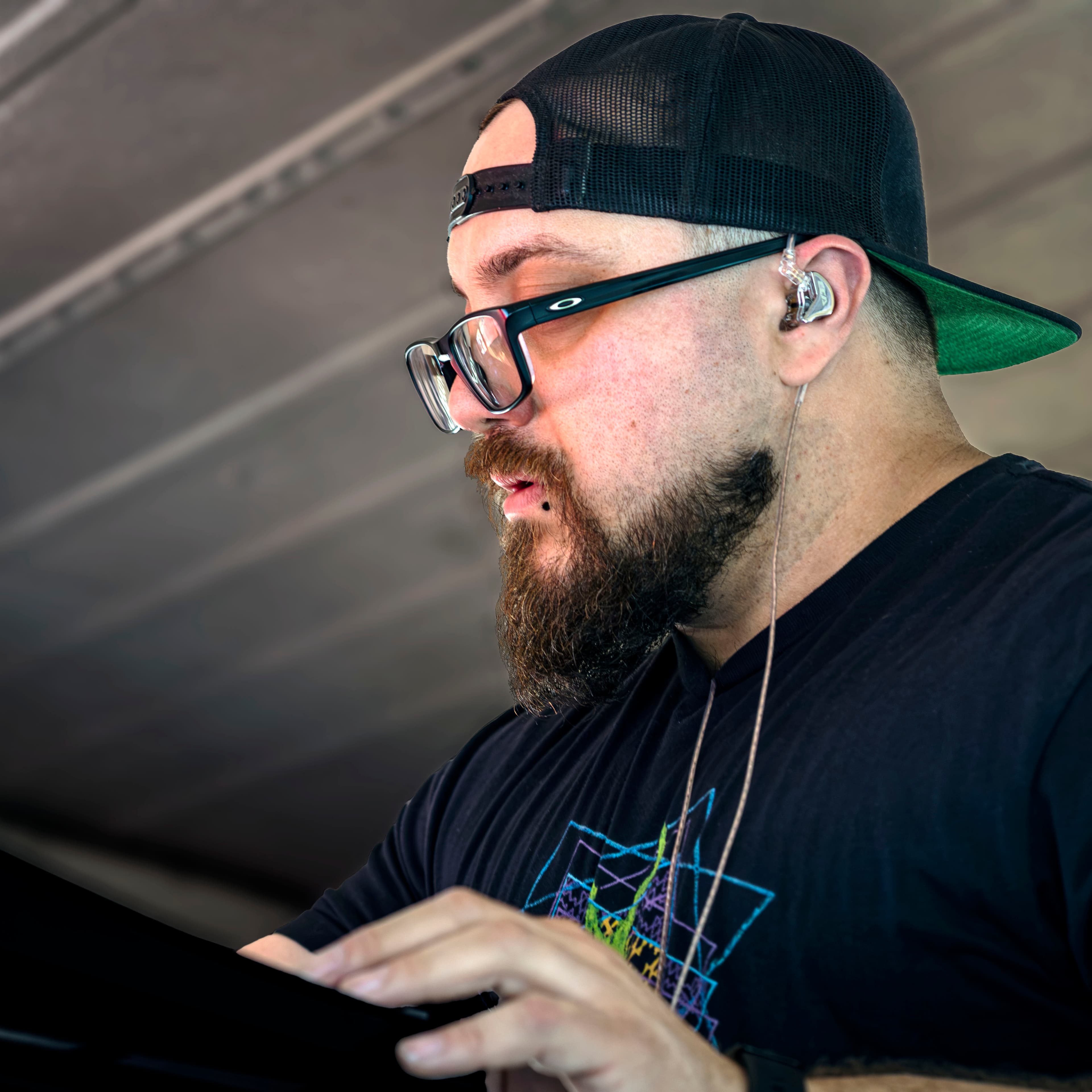
Sophizta pulled his name out of a junk email and his sound out of a step sequencer

A name pulled from a junk email
In 2008, Sophizta and his friends were drinking beers and reading spam, hunting for sentence fragments that stuck. One of them did. He liked the shape of it enough to carry it as an alias through his earliest days making music in Reason 5 with a MIDI controller, and he's still carrying it now. Keys have been the tether for as long as he can remember, through good stretches and bad, and he describes what he makes as ideas he rehearses and cements in hardware with an atmosphere of improvisation orbiting them to smooth the edges and make it psychedelic.
The guitar that didn't take
It started with School of Rock, of all things, and a seven-year-old's sudden urge to play. His mom, who he still thanks, bought him a guitar and an amp the next day. Lessons came from a teacher at the local music store who smelled funny in a way he only understood years later. A year in, it hadn't taken, so his mom bought him a digital Kurzweil piano instead, and keys just made sense to his brain. Years of theory followed, but the real click came the moment he was allowed out of the recital format and into his own ideas.
The synth he almost sold
A few years ago the Korg Minilogue XD was on its way out the door. He wanted something different and hadn't bothered to learn its depth, which he now calls a total space-cake move. Then he sat down with the sequencer, and bonding with it turned out to be the best thing he could have done. Learning to build patterns on hardware instead of in a DAW is what finally made everything cohere, and now he wants a second one. His still has no cap on the pitch bend joystick, so he just presses the bare nub, which he's decided makes it unique.
The Nexus
He calls the rig the Nexus, an arrangement with many permutations. The core is the Minilogue XD, an Arturia MicroFreak, a Moog Messenger, and a Roland TR-6S for beats. Beyond that it extends into a TC Helicon VoiceLive Touch 2, an ASM Hydrasynth Explorer, a Yamaha 61 for actual piano, and the Nord Stage when he wants the truly bulky configuration. A TR-8S is on the way, chosen deliberately over the flagship because he wanted the rudiments first. Everything sits under an overhead camera, which is why his videos look like a bird's-eye view of a small city.
Errata Fragment
His sets are always mutating, and right now they orbit an idea he calls the errata fragment: the human element, the error among the bytes. He's still fleshing out the abstraction, but the method is concrete. The week before a show he sits at the soundstage and reimagines what he has, running a track 20 BPM faster, moving it to a different key, changing where the sequence drops. Then he plays it, and the set effectively expires. His favorite part is losing control entirely, throwing a tape delay across the drum machine to announce that they are off the rails.
Old Town Pub, and a run through the Bay
The first real show as Sophizta was July 19 at Old Town Pub in Pasadena, a small room packed with 30 or 40 people who all got down, and so did he. Since then it's been a run: the South Hayward Market lot with Ground Up Multicast and Chris the Jungle, a Buzz Works night in SF that Frank Nitti handed him and he's calling Wavetable, and an Amalgam day party in Oakland where he's curating the second stage himself. That last one is the real ambition, gathering like-minded people and building the nights he can't find in Sacramento.
The wormhole
Eurorack is the next door. He calls the modules an Einstein-Rosen bridge and admits the sheer volume of them is a little intimidating to walk up to, but that's also exactly the appeal. What he keeps turning over is the obvious question: what would a Sophizta Eurorack set actually sound like? He's close enough to be asking, and he'd rather learn it from people already deep in it than from a browser tab.